Divorce is often spoken of in the language of loss—the fracturing of a foundation, the division of assets, the carving out of custody schedules. But Aaron and I had made a pact that the divorce would be a dissolution of a partnership, not an eradication of a family. We spent years navigating the landscape of co-parenting with a deliberate, surgical care. We were experts at the “Saturday drop-off,” the polite nod at school recitals, and the neutral exchange of holiday plans. It wasn’t always easy, but it was consistent. We were a team, defined not by the love we had lost, but by the child we were still raising.
Then came the evening that redefined everything.
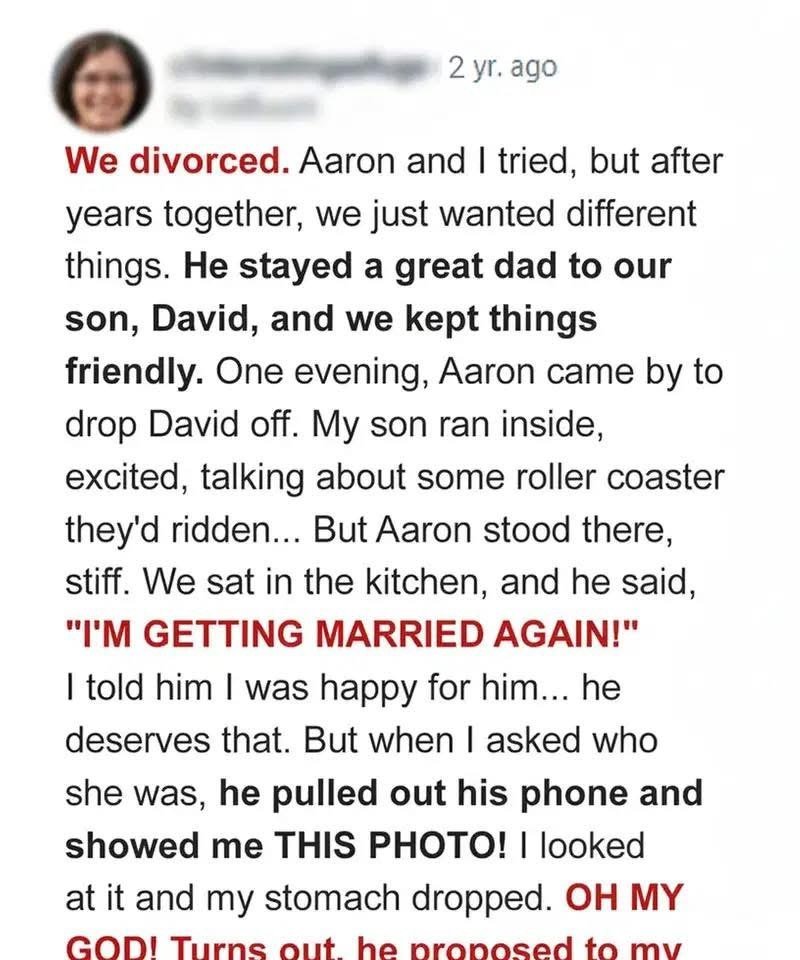
It was a standard Saturday drop-off. David had burst through the front door, a whirlwind of energy and adrenaline, regaling me with the sensory details of a theme park trip—the sticky cotton candy, the dizzying height of the rides, the sheer magic of the day. Aaron lingered in the doorway. He had that particular, nervous energy that a man possesses when he is about to step off a ledge into an unknown future.
We sat at the kitchen table, the low light of evening casting long shadows across the room. He took a breath, the kind that anchors a man before a confession. “I’m getting married again,” he said.
My first instinct was a genuine, reflexive warmth. I wanted him to be happy; he deserved to find a partner who aligned with his new life, a companion for the long road ahead. But then came the name. And then came the photo.
As I looked at the screen, the image of Emily—our neighbor, the woman who had brought me soup when I was sick, the woman who had sat with me on the porch during the early, suffocating days of our separation—the world felt very small.
For a heartbeat, there was a vacuum in the room. I braced myself for the surge of jealousy, the sharp sting of betrayal, or the cold, familiar bite of old resentment. But none of it came. Instead, a strange, resonant quiet washed over me. It was the feeling of a puzzle piece finally snapping into place.
I looked at Emily’s face—kind, familiar, and steady—and I realized that she was the best possible version of a stepmother I could have wished for my son. She wasn’t an interloper; she was a bridge.
“She’s wonderful,” I said, and as the words left my lips, I realized I meant them with every fiber of my being.
That night, after David was tucked into bed, his breathing slowing into the rhythmic, peaceful cadence of childhood, I sat in the dark and truly processed the shift. We are conditioned to believe that life moves in straight, predictable lines, and that when a path ends, we must walk in the opposite direction. But life is rarely so tidy. Sometimes, the path simply widens.
Our story hadn’t reached a catastrophic conclusion; it had simply undergone a metamorphosis. We were no longer a nuclear unit, but we were becoming something else—a constellation of people who loved the same boy, who respected the same history, and who were now connected by a web of genuine, shared history.
Change is almost always portrayed as something to be feared, a storm that threatens to uproot everything we’ve built. But that night, I understood that change can be an act of construction. It creates new families where we thought there were only voids. It turns old friends into new foundations.
Watching David grow—surrounded by his father, his father’s new wife, and me—wasn’t the ending I had imagined when I walked down the aisle all those years ago. But it was a beginning I hadn’t realized I needed. Love doesn’t have to follow the rigid lines of a marriage contract. It is fluid, resilient, and capable of taking shapes we cannot predict. And as I sat in the quiet of my home, I felt the rarest of gifts: the ability to let go of the past without losing the hope for the future.